Differences Between Commerce and Arts Before the Civil War
When was the Antebellum Period? The Antebellum Menstruum in American history is generally considered to exist the period before the Civil State of war and after the War of 1812, although some historians aggrandize information technology to all the years from the adoption of the Constitution in 1789 to the beginning of the Civil War. Information technology was characterized past the rise of abolition and the gradual polarization of the country between abolitionists and supporters of slavery. During this same time, the country'south economy began shifting in the due north to manufacturing as the Industrial Revolution began, while in the south, a cotton blast made plantations the eye of the economy. The annexation of new territory and western expansion saw the reinforcement of American individualism and of Manifest Destiny, the idea that Americans and the institutions of the U.Southward. are morally superior and Americans are morally obligated to spread these institutions.
The Cotton Economy In The Due south
In the S, cotton plantations were very assisting, at least until overplanting leached most of the nutrients from the soil. Advances in processing the fiber, from Eli Whitney's cotton wool gin to the development of power looms and the sewing auto, increased need for cotton to export from the South to England and the mills of New England. Plantation owners were able to obtain big tracts of land for trivial money, particularly after the Indian Removal Act was passed in 1830. These plantations depended on a big force of slave labor to cultivate and harvest the crop—most white farmers in the 19th century wanted and were able to obtain their own farms as the U.Due south. expanded southward and westward, and slaves not only provided a labor source that couldn't resign or demand higher wages, their progeny insured that labor source would continue for generations.
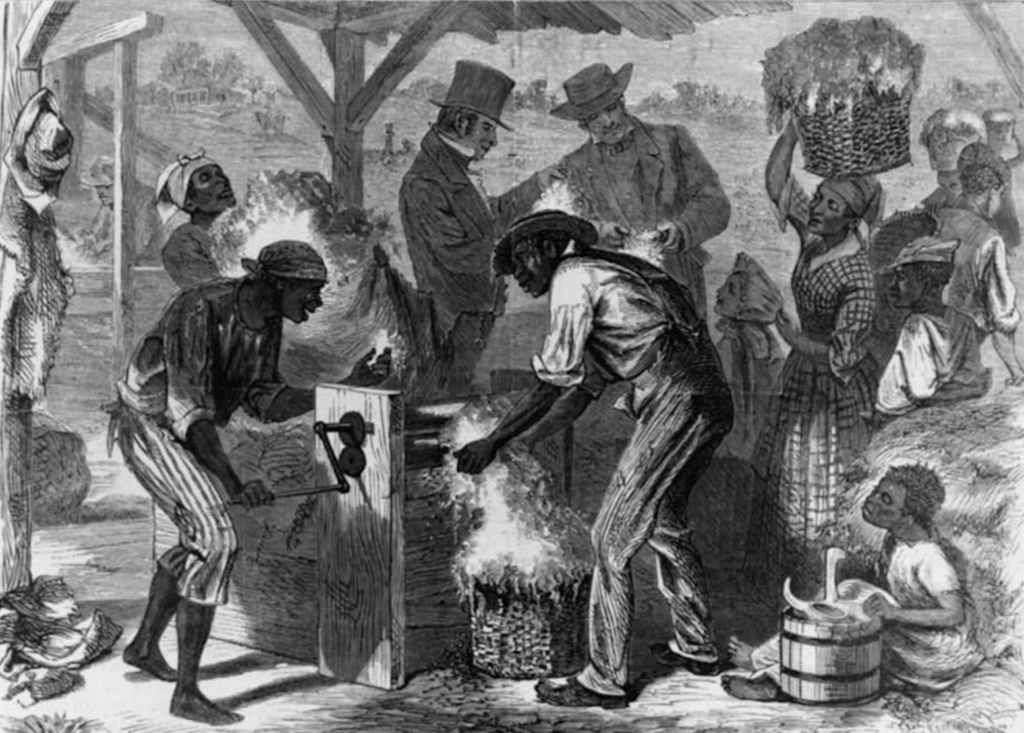
The demand for slave labor and the U.S. ban on importing more than slaves from Africa drove up prices for slaves, making it profitable for smaller farms in older settled areas such as Virginia to sell their slaves further south and west. Nigh farmers in the South had minor- to medium-sized farms with few slaves, only the large plantation owner'due south wealth, ofttimes reflected in the number of slaves they owned, afforded them considerable prestige and political ability. As the quality of land decreased from over-cultivation, slave owners increasingly institute that the majority of their wealth existed in the course of their slaves; they began looking to new lands in Texas and further west, besides every bit in the Caribbean and Central America, as places where they might expand their holdings and continue their way of life.
Early Industrialization and the Ascent in Manufacturing in the North
The early on industrial revolution began with textile manufacture in New England, which was revolutionized by Samuel Slater. Slater was a former apprentice in ane of Britain's largest cloth factories who emigrated to Rhode Island afterward learning that American states were paying bounties to people who could help replicate British textile machines, such as the spinning jenny, although the British government forbade the export of the machines or emigration of people with cognition of them. In 1787, the horse-powered Beverly Cotton wool Manufactory had begun operating in Beverly, Massachusetts; in 1793, Slater opened the first fully mechanized manufacturing plant in Pawtucket, Rhode Isle. His arrangement of contained mills and mill towns spread through the Blackstone Valley into Massachusetts.
In the 1820s, Slater's arrangement was supplanted past the more-efficient Waltham or Lowell system. The Waltham system included power looms in the mill, rather than Slater's practice of having weaving done at local farms. The Waltham arrangement also included specialized, trained employees to run the looms—mainly immature women—giving rise to the concept of wage labor, which gradually began overtaking previous forms of labor, such as apprenticeship and indentured servitude, family labor, and slavery in industrialized areas. A population shift from farms to cities had already begun, but the promise of ameliorate income in factory jobs accelerated that movement.
Manufacturing advances were not limited to the textile industry alone. Similar advances occurred in other industries, including the industry of equipment, mechanism, piece of furniture, paints, paper, and glass. Every role of American industry and production was afflicted.
Penny Press and Affordable Newspapers
Among the areas benefiting from advances in technology was the printing business, in particular, the printing of newspapers. Nearly newspapers in the early 19th century cost six cents a re-create and were affordable only to the upper classes, though a barter system frequently allowed readers to merchandise rags, whiskey or other goods for a subscription. Presses were still mitt-powered and essentially unchanged from Gutenberg's design until 1810, when High german printer Friedrich Koenig patented the steam-powered press. In 1843, American Richard 1000. Hoe fabricated a farther improvement with the rotary printing press, which arranged the material to be printed on a cylinder rather than a apartment plate, allowing a much larger volumes of textile to be printed—millions of copies in a twenty-four hours rather than thousands—at a lower cost. These advances led to a rise in the number of newspapers published, with more than available at prices affordable to the working form—by 1860, about 3,000 newspapers were published in the U.Southward. with a circulation of roughly 1.v million, in comparison with well-nigh 500 newspapers with a apportionment of near three,000 in 1820.
Papers were frequently read aloud in homes, bringing news of the government, politics, and local events. Significant speeches were sometimes printed in their entirety, giving politicians and social activists a much wider audience. Stories from one paper might exist reprinted in others, sometimes with local commentary or editorial rebuttals added. The advent of the telegraph meant news from afar places could be disseminated much more rapidly. Newspapers too relied on news—factual or not—provided in the grade of letters to the editor, which were commonly unsigned or made use of a pseudonym such as Plato or A True American.
In the 1830s, the "penny papers" led a revolution in journalism. They sold for a penny each, making news and even literacy itself more attainable to the working class. Many stories in the penny papers were sensationalist and embellished (to say the least). Modern tabloids tin trace their origins to the penny press—simply and so can modern mainstream newspapers. As the papers grew in apportionment, they increased in size from one canvas to ii or more. To make full those pages, editors added reporters with specific beats. Although sensational stories sold a lot of papers, so did opinion pieces. The increase in newspapers opened a new public forum—and ways of entertainment—that was attainable to all.
Canals, Turnpikes, and Early Railroads
Following the Revolutionary War, business and political leaders recognized the need to farther unify the country with roads. Local governments and individual turnpike and railroad companies began building roads and canals. The War of 1812 and the ascension of internal merchandise—between southern plantations and northern cloth manufacturers—proved that the trouble of internal transportation was far from solved and a federal system was needed, but diverse proposals to fund and build a national transportation system were deemed unconstitutional. The conservative Democratic Party in particular opposed federal funding of internal improvements. Instead, private companies proposed roads and canals, then enticed investors to provide fund edifice. In 1817, construction began on the Erie Canal to link Lake Erie and the Hudson River, inspiring a culvert-building blast that lasted into the 1840s when railroads supplanted canals. Turnpike companies also experienced a boom—past 1830, more than 10,000 miles of turnpikes were operating in the east. Commissioners were authorized to collect tolls and were responsible for maintaining the stretch of road under their care.
The culvert organization shortened trade routes into many parts of the interior, and port cities like Baltimore and Philadelphia saw some of their business concern shifting to ports along canal routes. To compete, they began investing in railroads to reach the interior of the country, starting a railroad boom in the 1830s that would concluding until the Civil War and begin anew following the war. Railroads grew so quickly in the 1830s that they surpassed the mileage of the canals. Many were short-run railroads built to connect ports with points inland, which were so connected to each other past rail. Railroads were faster, more direct, and more reliable than turnpikes or the canal arrangement. Past 1856, the eastern coast was connected past railroad to the western side of the Mississippi, Chicago, and the Great Lakes. Equally with canals and roads, railroads were built with individual funds generated "subscriptions"— the sale of stocks or bonds.
The 2d Enkindling
The 2nd Awakening was a religious revival that affected the entire state from about 1790 to the 1840s. It inspired the ancestry of the abolitionist movement in upstate New York. The basic theology popularized past the motion stated that individuals had a straight relationship with God that was unmediated past a church officials and that human dignity required freedom of will. Church membership increased, particularly amid Methodists and Baptists following revivals and tent meetings, which had their greatest attendance on the borderland. Many challenged traditional beliefs and founded new denominations, including the Mormons, the Shakers, the Seventh Day Adventists, and the Unitarian Universalists. This ascent in spirituality intensified evangelism in America, giving rising to a shift in morality and the advent of growing abolitionist and temperance movements.
Pre-Civil War Slave Rebellions
Slaves in the U.Due south. resisted their bondage through many passive forms of resistance, such as damaging equipment, working slowly, or keeping their culture and religious beliefs alive, although that often required secrecy. They also carried out open rebellions, risking everything for freedom. Several plots and rebellions occurred in antebellum America, notably Gabriel'southward Rebellion in 1800 in Richmond, Virginia; an uprising in Louisiana in 1811; and Denmark Vesey'due south conspiracy, which was uncovered in 1822 in Charleston, South Carolina.
1 of the bloodiest rebellions in U.Due south. history occurred in August 1831 when Nat Turner organized a slave rebellion in Southampton County, Virginia. Nigh 60 whites were killed and, afterward the rebellion was put down, the land executed 56 slaves accused of existence office of it. Militias and mobs formed in the paranoid chaos that followed and anywhere from 100 to 200 innocent slaves were killed in the aftermath. In response to these rebellions, slave codes and laws that express slaves' movements and their freedom to assemble in groups tightened considerably.
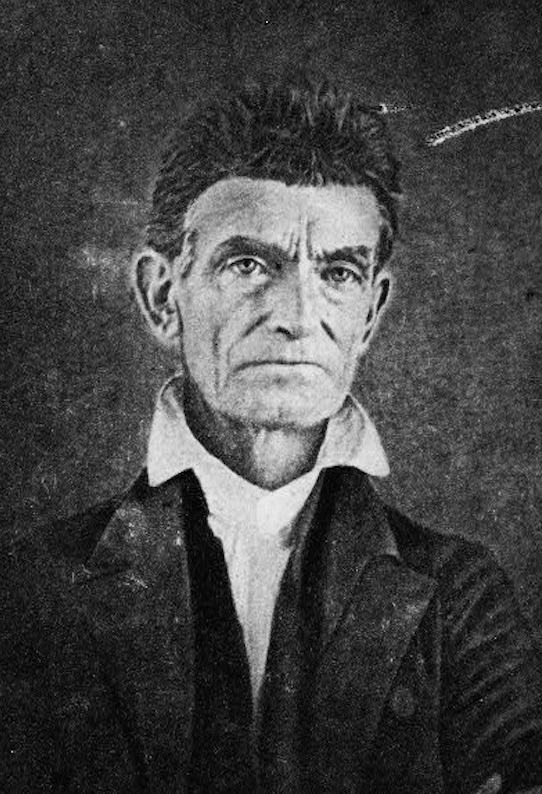
In spite of this, plots and actual rebellions in slave-belongings states continued into and through the Ceremonious War. In Oct 1859, radical abolitionist John Dark-brown led a grouping of followers in a raid to capture the U.S. armory at Harpers Ferry, Virginia (now Westward Virginia), in hopes of arming a full general slave uprising. The raid failed and Dark-brown and almost of his band were executed, but when Northern abolitionists made him into a martyr, information technology fed Southern fears that the Northward wanted to wage a war of extermination on Southern whites. John Chocolate-brown's Raid is considered one of the pregnant milestones on the road to the American Civil War.
Earlier The Civil War: Nullification Crisis
Objections in Southward Carolina to federal tariffs led to the Nullification Crunch in 1833. Having blamed the tariffs for part of the economical downturn in the 1820s, South Carolina passed a Nullification Ordinance in belatedly 1832 that declared federal tariffs unconstitutional and unenforceable in S Carolina, and made military preparations to resist federal enforcement. Although President Andrew Jackson obtained Congressional authorization to use armed services force against South Carolina in tardily Feb 1833, merely military confrontation was averted when Congress passing a revised tariff that met South Carolinian's demands and the country repealed its ordinance. When South Carolina next attempted to exit the Union post-obit the election of Abraham Lincoln in 1860 it did not go it alone, immediately sending ambassadors to the legislatures of other slave states to ask them to besides leave the Union and join the Palmetto State in forming a new Southern Confederacy. The ultimate result was iv years of ceremonious war that destroyed the Confederacy, ended slavery and established the supremacy of the federal authorities.
The Pre-Ceremonious War Rise of Abolitionist Movement
Although the arguments raised by the Missouri Compromise had died down in the 1820s, several events in the late 1820s and early 1830s, including the Turner Rebellion and Nullification Crisis, revived the debate and gave rise to the Abolition Movement. Because of the Second Awakening, some began to run across slavery equally a sin, with emancipation as the only way to absolve for this sin. The Quakers, who believed that all people were equal in the optics of God, had been speaking out against slavery since the 1600s, forming the start abolitionist grouping in the 1790s.
In 1833, William Lloyd Garrison and Arthur Tappan founded the American Anti-Slavery Society. Although highly controversial with huge, oftentimes physically threatening public opposition, past 1840 the society had about two,000 local auxiliaries with membership estimated to be betwixt 150,000 to 200,000, including freed blacks like Frederick Douglass. Members met, passed resolutions, and publicly argued against slavery both in speeches and in abolitionist newspapers. Their tone became increasingly confrontational, condemning slave owners every bit sinners and advising Americans to ignore the role of the U. S. Constitution that required runaways to be returned to their owners. Many abolitionists helped grade the Clandestine Railroad, leading slaves due north to liberty. Eventually, the lodge became part of a broader movement toward social reform, and many of its members joined in the movements supporting universal suffrage and feminism. The association of women's suffrage with the abolition move caused many Southerners, including many Southern women, to oppose the suffrage movement in the 20th century, which nearly resulted in the defeat of the 19th Subpoena.
By the 1850s, the Abolitionist Motility had gained enough traction to make Harriet Beecher Stowe'southward Uncle Tom's Cabin a bestseller, and it, in plough, led to increased membership in abolition societies. The novel'south social impact played an of import role in politics, contributing to the germination of the Republican political party and the election of President Abraham Lincoln—which in turn led to Southern secession and Civil War.
Manifest Destiny and Westward Expansion
Journalist John O'Sullivan coined the term "Manifest Destiny" in 1845, embracing the belief that Americans and the institutions of the U.S. are morally superior and therefore Americans are morally obligated to spread those institutions. The concept already existed and had to some caste ever since the 13 colonies won their liberty from Great britain; O'Sullivan gave it a proper noun.
Belief in these principles led many well-meaning whites to attempt to replace the traditional cultures of nomadic native American tribes with a lifestyle more in keeping with Euro-American farming communities. In other instances, it simply was used to justify the e'er-increasing need for more land in the westward.
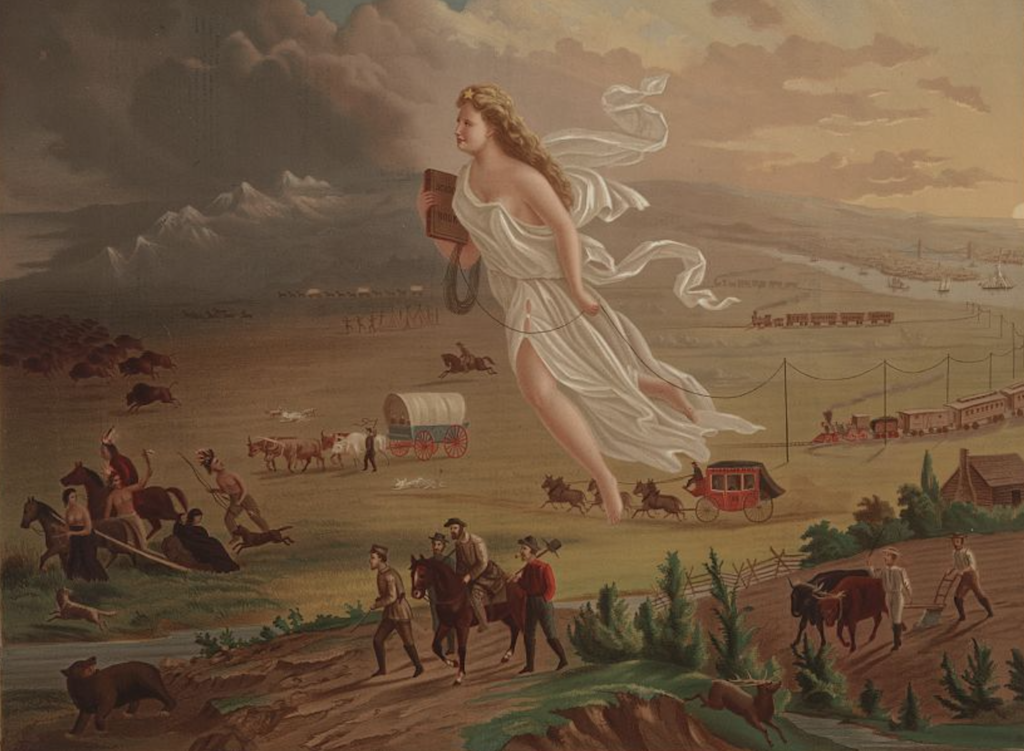
In 1844, James K. Polk of Tennessee was elected president on a platform of westward expansion. He faced off with the British over control of the Oregon Territory and oversaw a successful war with Mexico, 1846–1848. The Mexican War and settling the Oregon question meant that the United States at present stretched from the Atlantic to the Pacific. Western expansion soon took a major jump forwards with the California Gold Rush, as thousands from the eastern states, as well equally from foreign nations, headed for the territories of California and Nevada, hoping to strike it rich.
Furnishings of the Antebellum Period
The technological advances and religious and social movements of the Antebellum Menstruum had a profound result on the course of American history, including westward expansion to the Pacific, a population shift from farms to industrial centers, sectional divisions that ended in ceremonious war, the abolition of slavery and the growth of feminist and temperance movements.
historynet magazines
Our 9 best-selling history titles characteristic in-depth storytelling and iconic imagery to engage and inform on the people, the wars, and the events that shaped America and the earth. Sale! Save $seven.99 on your subscription today!
Source: https://www.historynet.com/the-antebellum-period-what-happened-in-america-before-the-civil-war/
0 Response to "Differences Between Commerce and Arts Before the Civil War"
Post a Comment